Can't find what you're looking for? Get in touch!


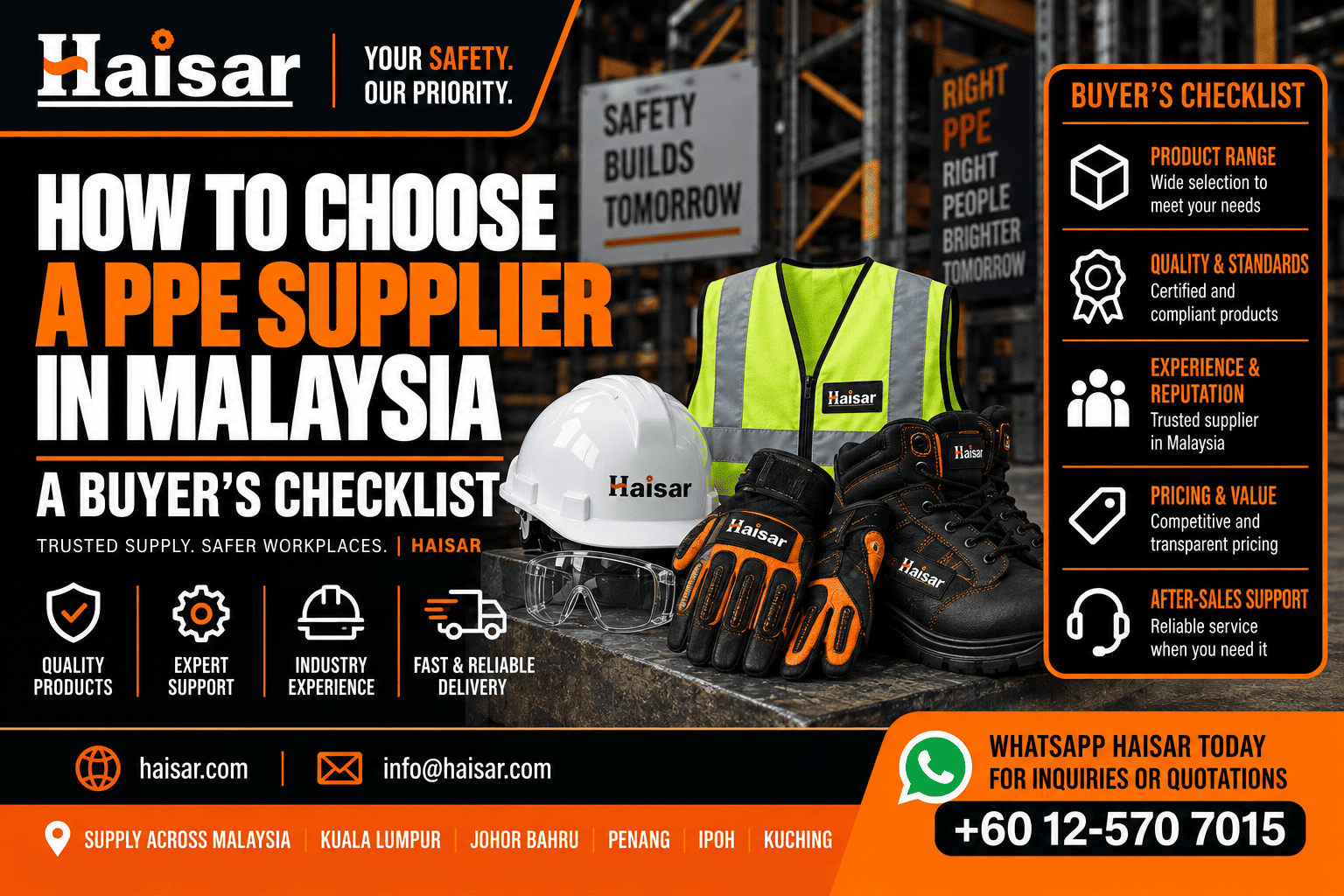
A good industrial PPE supplier is not the one with the lowest unit price on a quotation, it is the one that can back every line item with a real certificate, handle a bill of quantities without treating it like a retail order, and still answer the phone when a delivery goes wrong on a Friday afternoon. This page is a practical checklist for evaluating a supplier before you sign an account, not a sales pitch it applies whether you end up choosing us or someone else, and we would rather you use it than skip straight to the cheapest quote.
Buyers searching for how to choose a PPE supplier are usually further along than a first-time purchase they have an existing supplier that has just fallen short in some way, a new site or contract to set up, or a procurement policy that requires documented supplier evaluation before an account is opened. In every case, the mistake worth avoiding is the same one: comparing suppliers on price per unit alone, when the real cost differences show up in certification gaps, delivery reliability and how the relationship holds up when something goes wrong.
This is written as a set of criteria you can actually check, not a list of adjectives a supplier would apply to themselves. Take it to any supplier you are evaluating, including us.
What actually separates a supplier from a retailer
Most PPE buying mistakes in Malaysia are not about picking the wrong product, they are about picking a source that cannot support the product once it is on order. A supplier can list the right SIRIM-approved helmet at a competitive price and still fail you completely when the certificate does not arrive with the delivery, or the same SKU is out of stock the week your DOSH audit is scheduled.
The evaluation checklist
| Criterion | What good looks like | Red flag |
|---|---|---|
| Certification handling | SIRIM, DOSH, CE and relevant test data available on request, issued with the delivery order as standard practice | “We can get that for you” only after the order is placed, or no answer at all |
| Bill of quantities pricing | Will price a multi-line BOQ item by item, flag discontinued lines, and propose equivalents with a spec comparison | Only quotes per-unit prices and cannot handle a structured document |
| Stock depth & lead time honesty | States realistic lead times per category, and flags long-lead items upfront rather than at delivery | Promises everything “same day” regardless of category or distance |
| Account & PO terms | Can set up project account terms, PO-based ordering, and scheduled delivery against a project timeline | Retail-only transactions, no capacity for project-scale ordering |
| Technical advice | Will recommend the tier or standard that actually fits your hazard, including saying you are over-specified | Always recommends the most expensive option regardless of the task |
| Track record at your scale | Can name the categories and approximate scale of comparable projects supplied before | Vague or evasive about previous project scale |
| Registration & standing | A registered company (Sdn Bhd or equivalent) with a verifiable trading history | No verifiable company registration, or a very recent incorporation with no track record |
Score any supplier you are evaluating against this table, including us. If we fall short anywhere, tell us — we would rather hear it than have you find out the hard way. Ask us directly →
Questions worth asking before you sign
A supplier's answers to these tell you more than their catalogue does. Ask them directly, in writing if you want a record for your procurement file.
- “Can you issue SIRIM/DOSH certification with the delivery order, or only on request afterward?” The timing of the answer matters as much as the answer itself.
- “Can you price this bill of quantities line by line and flag anything discontinued?” Send a real BOQ, even a small one, and see how they handle it.
- “What's your honest lead time for this category to my location?” A supplier who gives a category-specific, location-specific answer is more trustworthy than one who says “same day” to everything.
- “Have you supplied a project of comparable scale before?” Ask for the categories and rough scale, not just a logo wall of past clients.
- “If I'm over-specifying, will you tell me?” Watch how they answer this one in particular it reveals whether the relationship is transactional or advisory.
- “What happens if a delivery is short or wrong?” A clear, specific process beats a vague reassurance every time.
Certification: the one thing never to skip
Every price-tier guide on this site helmets, arc flash suits, safety shoes, gloves comes back to the same point: certification is the first thing a suspiciously cheap quotation is missing, and it is the first thing a DOSH inspector or a client's HSE representative asks for on a site visit. It deserves its own section here because it is the single best predictor of whether a supplier is set up as a real industrial supplier or is reselling stock they cannot fully document.
In practice, this means asking for the actual certificate, not a claim of compliance. A SIRIM certification number, DOSH approval documentation, or a CE/ASTM test report should be something a supplier can produce on request before you commit to an account, not something that surfaces only after a problem occurs. If a supplier hesitates, delays, or cannot name which standard a product is certified to, treat that as your answer.
What we do, plainly stated
- Since 2012. Haisar Supply & Services Sdn Bhd, Co. No. 985158-T, based in Kulai, Johor.
- SIRIM and DOSH documentation issued with the delivery order on the lines that carry it, not requested after the fact.
- Bill of quantities pricing. Send a BOQ and we price it line by line, flag discontinued items, and propose equivalents with a spec comparison.
- Eight categories on one account: PPE, electrical safety, fire safety & rescue, emergency responder, working at heights, working with chemical, customised workwear and project supplies.
- We will tell you when you are over-specified. It shows up throughout our pricing guides deliberately — a bigger order today at the wrong tier is not a win for either of us if it is the wrong product.
Run the checklist against us
Ask us any of the questions above. If you are setting up a new account or evaluating suppliers for an existing site, we would rather answer directly than have you guess.
Haisar Supply & Services Sdn Bhd · No. 7501, Jalan Enggang 19, Bandar Putra, 81000 Kulai, Johor · Seremban branch 011-3307 7509 · contact details
Questions we get asked
What's the biggest mistake companies make when choosing a PPE supplier?
Comparing suppliers on per-unit price alone. The real cost differences show up later in missing certification at audit, in a bill of quantities the supplier cannot handle, or in a delivery that fails right before a mobilisation date. Price matters, but it is the last thing to compare, not the first.
Should I use one supplier for everything, or split categories across several?
There is a real case for consolidating onto one supplier that can genuinely cover your categories: fewer accounts to manage, one certification file, and simpler bill of quantities pricing. It only works if that supplier actually stocks the range, though — consolidating onto a supplier that is thin in half your categories just moves the risk around rather than removing it.
How do I verify a supplier's certification claims are real?
Ask for the actual certificate or approval number, not a verbal claim, and check it against the relevant registry where one exists (SIRIM's product certification database, for example). A supplier confident in their documentation will not hesitate to produce it before you commit to an account.
What should I ask for in a bill of quantities quotation?
Line-by-line pricing against your actual BOQ, not a summarised total. Ask the supplier to flag any item that is discontinued or long lead time and to propose a documented equivalent rather than silently substituting something different.
Is it reasonable to expect same-day delivery from a PPE supplier?
For routine restock within a reasonable radius, often yes. For a fixed mobilisation date, a specific cal rating or size run, or a location genuinely far from the supplier's base, a realistic lead time quoted upfront is more trustworthy than a same-day promise made to every enquiry regardless of category or distance.
What documentation should a supplier provide with every delivery?
At minimum, a delivery order matching the quotation, and certification documents (SIRIM, DOSH, CE or the relevant standard) for any line that carries them. If your industry or client requires additional documentation for vendor registration, confirm at quotation stage that the supplier can produce it before the order is placed.
