Can't find what you're looking for? Get in touch!


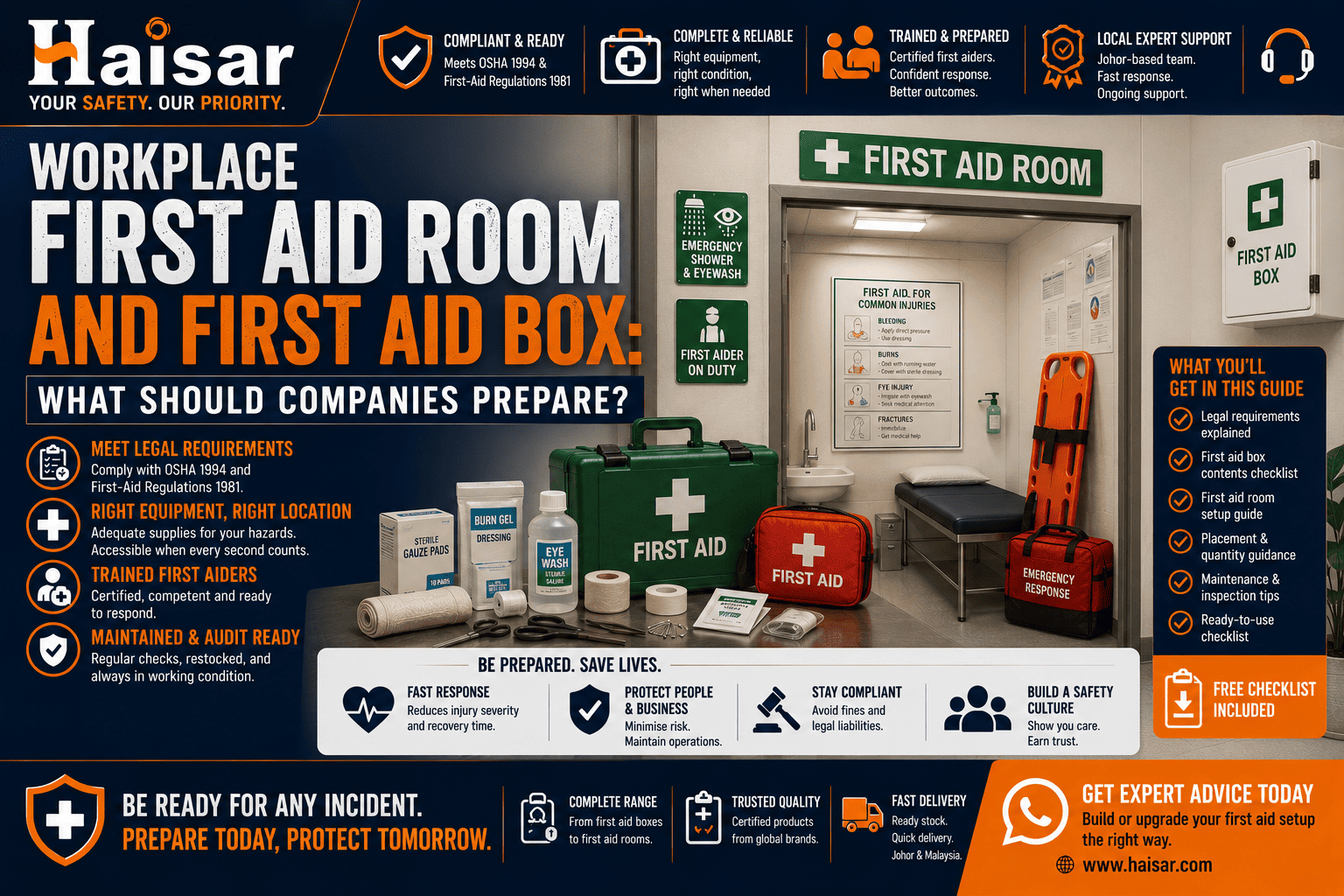
Ask most companies in Malaysia where their first aid box is and they will give you a room or a wall location. Ask them when it was last restocked, whether the contents match the hazard profile of the work, or whether the first aider assigned to that box is still on the same shift - and the confidence drops sharply.
First aid provision is one of the most universally required workplace safety obligations in Malaysia, and one of the most commonly maintained at a level that satisfies a casual glance but fails at the point of use. A first aid box with three plasters, a bottle of antiseptic with an expired date, and an eye pad that was used two months ago is not first aid provision. It is a compliance record that has not been updated to reflect the actual condition of the equipment.
This guide covers what Malaysian companies are required to provide under the Occupational Safety and Health Act 1994, what a properly stocked first aid box and first aid room actually contain, how to calibrate the provision to the specific hazards present in your workplace, and how to maintain first aid equipment so it works at the moment it is needed.

Last reviewed: July 2026
Fire hose reels and fire blankets serve very different purposes. A hose reel provides a continuous water supply for suitable fires involving ordinary combustible solids. A fire blanket is a single-user device designed to smother a small, containable fire by excluding oxygen. Neither product is suitable for every workplace, and neither should be purchased as a generic “BOMBA compliance” item without checking the building’s approved fire-safety requirements and actual hazards.
For Malaysian employers, building owners, facility managers and project teams, the correct approach is to verify what the approved plans and applicable fire-safety requirements call for, choose equipment that meets the relevant standards, maintain it through properly registered providers where required, and train occupants to prioritise alarm, evacuation and personal safety.

Most factories and industrial sites in Malaysia have some emergency response equipment on site. A first aid box in the supervisor's office. A fire extinguisher by the main door. An eyewash station installed during the original fit-out that nobody has checked since commissioning.
What most sites do not have is a complete, systematically organised emergency response setup that covers every plausible incident category, with equipment in the right location, maintained to the correct standard, and known to the people who would need to use it in the first two minutes of an incident.
That gap matters most at the moment it matters most - when the incident has already happened and someone is standing in front of a chemical splash, an unconscious colleague, or a spill spreading toward a drain, trying to remember where the relevant equipment is and whether it is in working condition.
This guide gives HSE managers, safety officers, and procurement managers at Malaysian factories and industrial facilities a complete reference for emergency response equipment selection and placement, organised by incident category. At the end is a downloadable checklist that covers every category in this guide, ready for use as an audit tool, a procurement reference, or an onboarding document for new site safety personnel.
Last reviewed: July 2026
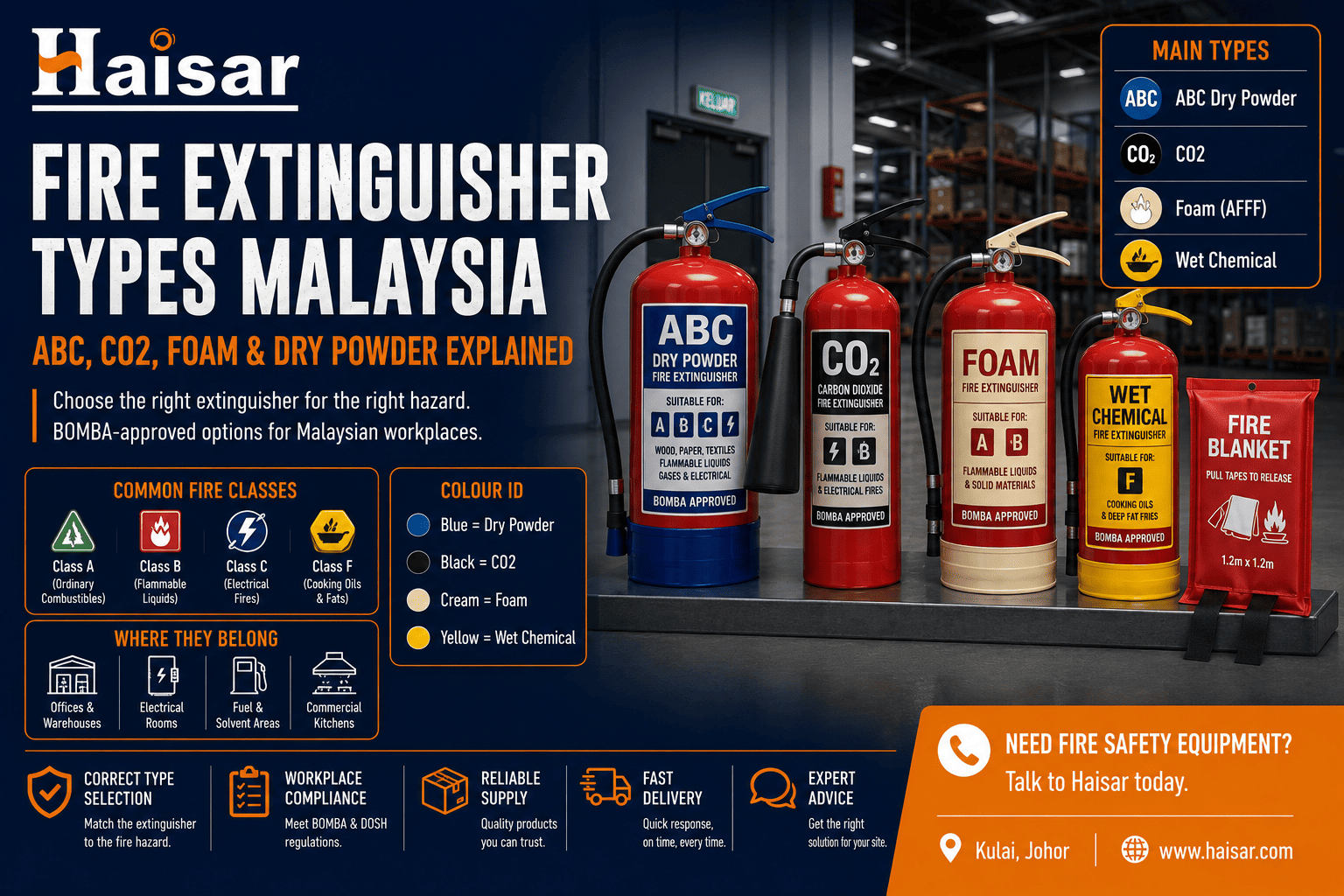
Choosing a fire extinguisher is not simply a matter of buying a red cylinder and mounting it near an exit. Different extinguishing agents are designed for different fuels, and using the wrong agent can spread the fire, damage valuable equipment or expose the user to electrical, chemical or pressure hazards.
For Malaysian workplaces, extinguisher selection should be based on the fire hazards present, the fire-class and fire-rating markings on the product, the building’s approved fire-safety requirements, and the applicable Malaysian Standards. The type, number, capacity and placement should be confirmed through a site-specific fire-risk assessment and, where required, by a competent person or registered fire-safety contractor.

Project sites in Johor do not stop moving because a safety equipment delivery is late. The workers are there. The plant is mobilised. The programme is running. And when the PPE has not arrived, the site faces a choice between proceeding without adequate equipment, which creates compliance risk and safety risk, or stopping work and absorbing the cost of a programme delay, which can run into tens of thousands of ringgit per day on a large civil or industrial project.
Neither option is acceptable. Both are preventable with the right supply arrangement.
This is the practical reality of safety equipment procurement for project sites in Johor. The Pasir Gudang petrochemical corridor, the data centre construction programme in Iskandar Puteri, the solar farm installations across Kluang and Kota Tinggi, the highway and infrastructure works on Johor's expanding road network, and the ongoing shipyard and marine operations along the Johor Strait all run on tight programmes where procurement delays have direct and measurable consequences.
This guide explains why fast, reliable safety equipment delivery in Johor matters for project procurement, what the common delay triggers are and how to avoid them, and why a local Johor-based supplier makes a material difference to delivery performance compared to suppliers based elsewhere on the peninsula.

Most procurement managers buying PPE for a construction or industrial project in Malaysia have used both channels at some point. An online marketplace order for a fast top-up. A local supplier relationship for the project bulk. And at some point, most have also experienced the failure mode of each.
The marketplace delivered the wrong cut-resistance rating. The local supplier quoted a six-week lead time two weeks before mobilisation. The marketplace shipped from a Peninsular warehouse but did not update the product listing to reflect the out-of-stock position at the Johor fulfilment centre. The local supplier's sales rep promised a non-standard item was available and it was not.
Neither channel is inherently better. What matters is understanding what each channel is actually good at, where each one fails, and which one is better aligned with the specific requirements of PPE procurement for a project buyer in Malaysia. That is what this guide sets out to answer.

Most PPE procurement in Malaysia happens reactively. A site supervisor runs out of gloves mid-project and raises an urgent purchase order. A new hazard is identified during a toolbox talk and the HSE manager realises the site does not have the right respirator. The shutdown team arrives on Monday morning and three sizes of FR coveralls are missing from the order because nobody confirmed the full size distribution.
Reactive procurement is expensive, slow, and creates compliance gaps at the moments when compliance matters most. The project has not stopped. The work is happening. The workers are there. And the PPE is not.
A PPE procurement plan solves this by turning a reactive function into a planned one. It maps the full scope of PPE requirements to the project programme, establishes the specification for every item before the first purchase order is raised, identifies lead times before they become delivery problems, and creates a documentation and approval framework that survives the change of personnel and programme shifts that every project experiences.
This guide explains how to build a PPE procurement plan for a construction or industrial project in Malaysia, step by step, with a downloadable template at the end that gives your team a starting framework for every future project engagement.

Large-scale PPE procurement is a different discipline to routine site restocking. When a project mobilises five hundred workers in three weeks, when a facility runs a planned shutdown requiring a thousand FR coveralls for an incoming contractor workforce, or when a principal contractor issues a standardised PPE specification across twelve sub-contractor packages simultaneously, the procurement function faces challenges that a standard catalogue purchase cannot solve.
Volume creates complexity. Size distribution across a large workforce is rarely uniform. Lead times for imported or customised products extend beyond what reactive ordering can absorb. Compliance documentation must be collected and maintained across every product category, not just the one the HSE manager remembered to request. Delivery must be coordinated with a project programme that does not stop because the gloves have not arrived yet.
This guide is written for procurement managers and HSE officers at organisations in Malaysia managing large-scale PPE orders. It explains how bulk PPE procurement differs from routine purchasing, the process that makes it manageable, and how Haisar Supply and Services supports organisations across Johor and peninsular Malaysia who need a supply partner capable of operating at scale.

Safety equipment does not remain compliant simply because it is still on site. Helmets can become brittle, gloves can lose chemical resistance, respirator cartridges can expire, harness webbing can be damaged, and fire extinguishers can become overdue for inspection. A proper safety equipment inspection checklist helps Malaysian employers identify worn, expired, damaged or unsuitable equipment before it fails during real work.
This guide gives HSE officers, procurement teams, factory managers, contractors and project teams a practical inspection and replacement framework for PPE and emergency equipment used in Malaysian workplaces. It should be used together with a site-specific HIRARC, manufacturer instructions, product certification documents and any client or project requirements.
